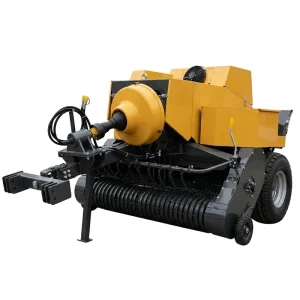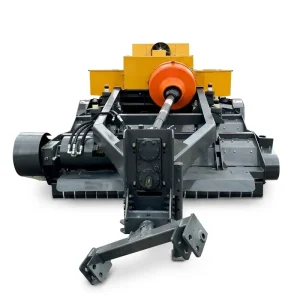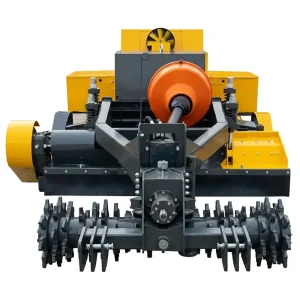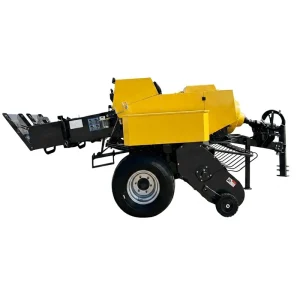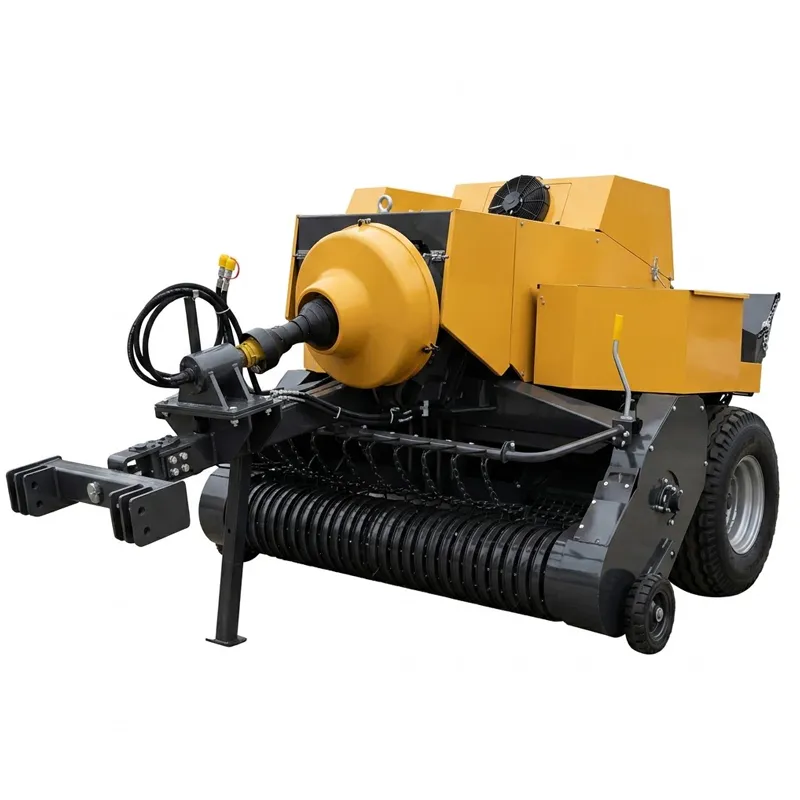
EP-4965×2640×1750 mm (L×W×H) 1900 mm Picking Width Square Baler
The 9YF-1900 belongs to the mid-mounted trailed square hay baler category — a format that offers an important operational advantage over front-mounted or self-propelled alternatives at comparable power inputs. The trailed hitching method places the machine’s weight on its own running gear rather than hanging it from the tractor’s three-point linkage, reducing rear axle loading and improving stability on slopes and soft post-harvest soils. This matters particularly on Korean paddy field headlands and Mongolian grassland terrain, where consistent traction is harder to maintain during wet autumn baling seasons.
Farmers and contractors asking “how does a square baler work” will find the 9YF-1900 follows the same proven mechanical sequence used across the global square baler industry: continuous pickup, timed plunger compression, automatic knotting, and rearward bale ejection — all coordinated by a single PTO-driven gearbox. What makes the 9YF-1900 specifically worth specifying is its calibrated match between pickup width, compression chamber size, and power requirement. The 1900 mm spring tooth pickup is wide enough to handle combine-deposited windrows in a single pass, while the 36.8–73.5 kW power window keeps it within reach of tractors that Korean and Mongolian farms already own. It is one of the most field-practical square baler machines available in this power class.
EP-9YF-1900 | 4965×2640×1750 mm (L×W×H) Spring Tooth Type 1900 mm Picking Width Square Baler
The EP-9YF-1900 is a mid-mounted, trailed square baler built to handle wheat straw, rice straw, cotton straw, corn straw, and a wide range of forage grasses across paddy fields, dryland plots, and level arable terrain. A 1900 mm spring tooth pickup, a fork feeding mechanism, and two D-type knotters work together to produce dense, uniformly tied 460×360 mm bales at a matched power range of 36.8–73.5 kW — making this square baler machine accessible to a broad spectrum of mid-range farm tractors without demanding a high-horsepower dedicated unit. If your operation requires a reliable square hay baler that bridges the gap between an entry-level small square baler and a heavy commercial large square baler, the 9YF-1900 sits precisely in that productive middle ground. Its compact transport footprint and competitive field throughput make it equally practical for Korean family farms, Mongolian pastoral operations, and Eastern European contract baling services.
Technical Specifications
All parameters below are taken from the 9YF-1900 production specification sheet. Verify tractor PTO output, hitch point height, and drawbar load ratings against these figures before ordering. Custom compression chamber sizes and alternative power configurations are available on OEM request.
| เลขที่ | Parameter | หน่วย | ข้อกำหนด |
|---|---|---|---|
| 1 | ชื่อรุ่น | — | 9YF-1900 Square Baler |
| 2 | Hitching Method | — | Towed-Type (Trailed) |
| 3 | Picking Width | มม. | 1900 |
| 4 | Feeding Inlet Width | มม. | — |
| 5 | Picker Structure | — | Spring Tooth Type |
| 6 | Feeder Structure | — | Fork Feeding Mechanism |
| 7 | Knotter Type | — | D-Type |
| 8 | Number of Knotters | pc | 2 |
| 9 | Compression Chamber Section (W×H) | มม. | 460×360 |
| 10 | วิธีการอัดก้อน | — | Automatic Rope Baling |
| 11 | Matching Power Range | กิโลวัตต์ | 36.8 – 73.5 |
| 12 | Overall Dimension (L×W×H) | มม. | 4965×2640×1750 |
| 13 | น้ำหนักเครื่องจักร | กก. | 1850 |
Dimensions given as Length × Width × Height in millimetres. Weight is approximate and subject to variation by regional specification.
Five Key Advantages
The 36.8–73.5 kW power range covers a broad spectrum of mid-range farm tractors — from compact 50 hp units to standard 100 hp field tractors. Farms operating in South Korea, Mongolia, Russia, and Belarus can deploy this square baler without a dedicated high-horsepower purchase, making it a practical starting point for operations transitioning from manual straw collection.
The 1900 mm spring tooth pickup reel lifts windrows cleanly from flat, level ground without stone damage — an important characteristic for Korean paddy fields and Mongolian flatland operations where buried stones are uncommon but surface hardness varies. Spring teeth absorb impact better than rigid tines and maintain pickup efficiency in light or lodged crop conditions.
The plunger compression system produces bales at densities that significantly outperform manual bundling and net-wrapped round bale alternatives on a per-unit-volume basis. High-density small square bales of hay or straw stack tightly in barn bays, fit standard container dimensions for export, and resist moisture infiltration during outdoor storage — three qualities that directly support the traded hay and biomass markets in Korea and East Asia.
Fully automatic rope baling eliminates manual twine threading between bales. The timing mechanism triggers twine needles and D-type knotters at consistent density points, maintaining knot integrity across varied crop moistures — from dry cereal straw in summer to slightly damp alfalfa in autumn. Consistent knots mean fewer broken bales during mechanical loading and transport.
Designed to operate on both paddy field terrain and conventional dryland soils, the 9YF-1900 handles the surface-condition variability that single-crop balers struggle with. Its mid-mounted balance and trailing running gear allow it to follow irregular field surfaces without the frame stress that front-mounted square balers experience on Korean upland plots with cross-slope headlands.
How Does a Square Baler Work — 9YF-1900 Sequence
The PTO shaft from the tractor drives the main gearbox, which distributes power to three parallel systems: the pickup reel and feeder, the plunger crankshaft, and the knotter cam timing chain. As the machine moves forward, the 1900 mm spring tooth reel rotates continuously, lifting crop material from the windrow and feeding it rearward into the fork feeding mechanism. The fork mechanism meters and pre-compresses material into the compression chamber in controlled charges, preventing the slug-feeding surges that can overload the gearbox in less-controlled feeder designs.
Inside the compression chamber, a reciprocating plunger driven by a heavy flywheel-damped crankshaft compresses each charge against the growing bale column. The flywheel stores kinetic energy between compression strokes, smoothing the torque demand on the tractor PTO and gearbox — particularly important at the lower end of the 36.8 kW minimum power range. When the bale sensor registers the preset density, the knotter trigger fires: twine needles arc through the bale chamber, and the two D-type knotters simultaneously tie and cut the twine on both sides of the bale cross-section. The finished bale ejects rearward onto the field surface, the needles retract, and the chamber refills for the next cycle. The entire sequence from trigger to ejection typically takes under two seconds at normal field speed.
Materials & Build Construction
Welded Steel Main Frame
The main chassis is fabricated from heavy-section hot-rolled steel sections, fully welded and gussetted at all load-bearing nodes. The frame must absorb the repeated impact loads generated each time the plunger reaches bottom-of-stroke compression — forces that accumulate to millions of cycles over a machine's field life. Frame geometry is verified by finite-element analysis to eliminate fatigue cracking at the highest-stress welds around the plunger housing.
Plunger & Chamber Liners
The plunger face and compression chamber walls are lined with hardened wear-plate steel. Replaceable wear inserts at the plunger corners and chamber entry points extend service intervals without requiring full plunger or chamber replacement. Consistent chamber geometry across the wear life of the liners maintains bale density and shape — essential when producing small square bales of hay for the Korean export and livestock feed markets where bale dimension uniformity is a commercial requirement.
Spring Tooth Pickup Reel
Individual spring teeth are formed from oil-tempered spring steel and are individually bolted to the pickup reel tube — allowing single-tooth replacement after stone strike damage without removing the full reel assembly. This field-serviceability feature is significant for Korean paddy-to-dryland operations where stone contamination risk varies by field history.
D-Type Knotter Assembly
Precision-machined alloy steel bill hooks with surface-hardened bearing surfaces. The knotter timing is fixed to the plunger crankshaft through a positive-drive chain, ensuring correct bill hook position relative to plunger position across the full power and speed range — preventing the timing drift that causes missed knots during heavy crop loading at the upper end of the 73.5 kW power range.
Regional Regulatory & Compliance Framework
Agricultural machinery imports and on-farm use are governed by different regulatory bodies in each target market. Understanding these requirements in advance prevents import delays and ensures your baler can be legally operated without post-delivery modifications.
South Korea
The Act on Promotion of Agricultural Mechanisation governs the import and use of farm machinery. The Rural Development Administration (RDA) operates a voluntary performance certification programme for imported agricultural equipment; RDA-certified machines are eligible for government purchase subsidies targeted at small and medium-scale Korean farms. Importers should request full Korean-language operator manuals and parts lists to support RDA registration documentation. PTO shaft guarding must meet the minimum shielding requirements applicable under Korean industrial safety law.
European Union
Trailed agricultural machinery marketed in EU member states must carry CE marking in accordance with Machinery Directive 2006/42/EC. This directive is being replaced by EU Machinery Regulation 2023/1230, which will apply from January 2027. ISO 11684 applies to safety sign requirements. Square balers specifically require guard documentation for the flywheel, PTO shaft, and knotter zone under Annex I of the directive. Manufacturers must maintain a Technical Construction File for inspection by market surveillance authorities.
Russia & EAEU
Machinery sold into the Eurasian Economic Union — covering Russia, Kazakhstan, Belarus, Armenia, and Kyrgyzstan — must carry EAC (Евразийское соответствие) conformity marking under Technical Regulation TR CU 010/2011 on machinery safety. Agricultural machinery is explicitly covered and requires third-party conformity assessment by an accredited EAEU certification body. Documentation must be submitted in Russian. Importers operating in Belarus are subject to the same EAEU framework as Russia.
Mongolia
The General Authority for Standardisation and Metrology (MASM) manages import certification for agricultural equipment in Mongolia. Machines above a set output threshold require a technical inspection certificate at the point of customs clearance. Mongolian buyers typically request Chinese or English documentation; importers should confirm that operator manuals, spare-parts lists, and lubrication schedules are available in a language accessible to local service technicians before confirming the order.
Application Scenarios
The 9YF-1900 is designed for multi-crop versatility across paddy and dryland environments. The following use cases represent the primary deployment contexts where this square baler machine delivers measurable value over manual or round-bale alternatives.
Rice & Wheat Straw — Korea & Japan
Post-combine straw collection on Korean and Japanese cereal farms is one of the most time-critical agricultural operations of the year — the baling window between combine exit and field re-entry for tillage or seeding can be as short as five days in wet autumn conditions. The 9YF-1900's 1900 mm pickup width handles the wide windrows left by modern wide-cut combines efficiently, and the compact 4965 mm overall length fits on the narrow headlands typical of Korean paddy field blocks. The resulting small square hay bales can be sold directly to local mushroom cultivation, biomass, or livestock bedding markets without further processing.
Forage Grass & Alfalfa — Mongolia
Mongolian livestock producers cutting and baling native grassland or cultivated alfalfa for winter fodder require bales with sufficient density to survive outdoor stacking under snow load for four to six months. The 9YF-1900's plunger compression consistently achieves bale densities that resist settling and shape loss during this storage period. Square hay bales also stack into stable columns that reduce feed loss due to mould penetration from rain ingress — a practical advantage in Mongolian steppe conditions where covered barn storage is often insufficient for the full winter feed inventory.
Cotton & Corn Stover — Russia & Central Asia
Cotton straw and corn stover baling in Russian and Central Asian agricultural regions requires a feeder and compression system capable of handling the coarser, stiffer fibre structures of these crops compared to cereal straw. The fork feeding mechanism on the 9YF-1900 pre-compresses and meters these materials into the chamber in controlled charges, preventing the bridging and blockages that cause unplanned field stoppages during the narrow autumn harvest window. The resulting bales are used in bioenergy feedstock supply chains and as livestock roughage supplements in mixed farming systems.
Contract Baling Services
The 9YF-1900's compatibility with a wide tractor power range makes it well-suited to contract baling businesses serving multiple farm clients with different tractor models. A contractor in Korea's Gyeongnam province, for example, can operate this square baler behind a 50 hp compact tractor on small paddy plots in the morning and switch to a 90 hp row-crop tractor for larger dryland fields in the afternoon without changing the baler. This flexibility reduces equipment idle time and broadens the range of clients a single machine can serve.
Compatible Components & Related Products
The 9YF-1900 is part of an integrated supply system. The drivetrain components below are matched to this machine's torque and speed requirements, allowing you to source the baler and its critical wear components from a single supply chain — reducing lead times and eliminating compatibility uncertainty.
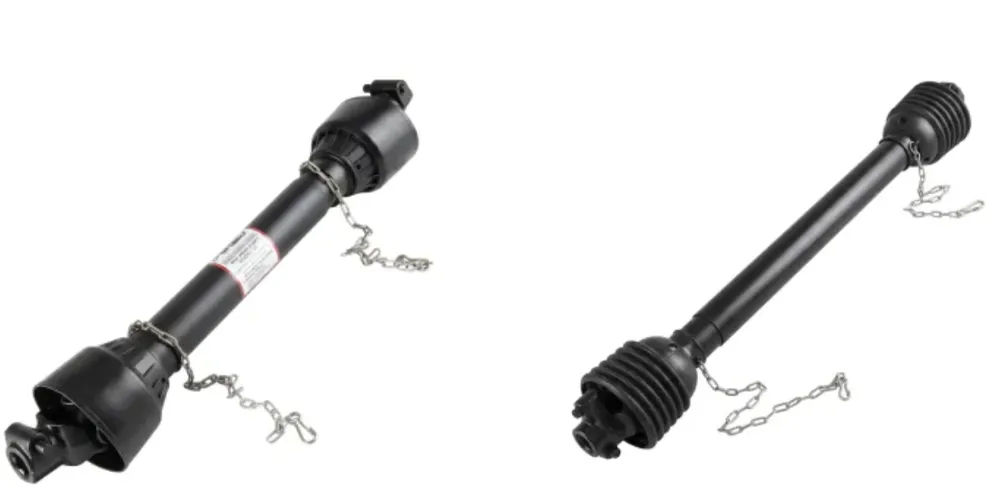
PTO Shaft for Square Balers
The connection between your tractor and the 9YF-1900 gearbox is only as reliable as the PTO shaft bridging them. An improperly rated shaft can fail under peak torque during dense-crop plunger cycles; an unguarded shaft creates a hazardous entanglement zone that violates machinery safety requirements in Korea, the EU, and the EAEU. Our PTO Shaft for Square Balers series is rated and shielded to match the 9YF-1900's power window, with CE-compliant guarding for export markets and EAEU documentation for Russia and Belarus. Every shaft is load-tested before dispatch.
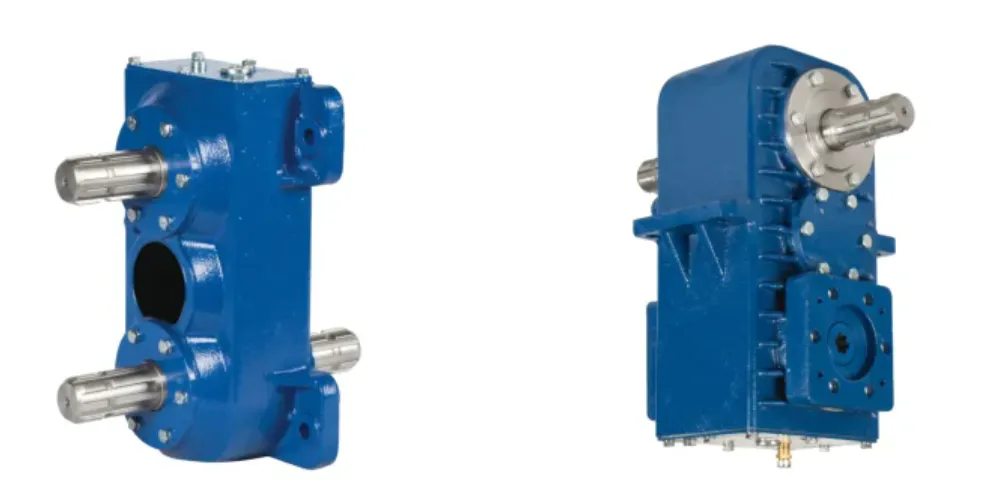
Square Baler Gearbox
The gearbox distributes PTO power to the plunger, knotter cam, and feeder simultaneously — it is the mechanical nucleus of the entire baling cycle. A gearbox not matched to the 9YF-1900's plunger stroke frequency and peak torque requirements will suffer premature bearing and gear wear, shortening overhaul intervals and increasing downtime during the harvest season. Our square baler gearbox replacements are manufactured to the same load specifications as the original factory fitment, maintaining correct timing between the plunger, needles, and knotters after installation.
About Us — Engineering That Comes From the Field
The people who built this square baler machine are not just engineers — they include working farmers and service technicians who have spent seasons managing post-harvest straw in real field conditions. When a baler fails during the peak three-day window between combine exit and soil preparation, the cost is not just repair time: it is missed crop establishment dates and reduced yield the following season. We designed our machines around that reality.
When we started in 2021, our production floor covered 2,000 square metres. It now spans 32,000 square metres of modern, intelligent manufacturing capacity, and annual output has grown from 100 to 2,000 units per year. Our sales reach extends across Mongolia, Russia, and Belarus — markets where seasonal reliability and parts availability are the primary purchase criteria, not showroom aesthetics. That export track record is built on machines that work under pressure, in difficult conditions, with limited local service infrastructure.
Standard catalogue products, OEM custom configurations, and private-label arrangements are available. Direct factory ordering, pre-shipment inspection, and regional parts stocking programmes can be arranged for volume buyers and importing distributors.
Frequently Asked Questions
บรรณาธิการ: PXY