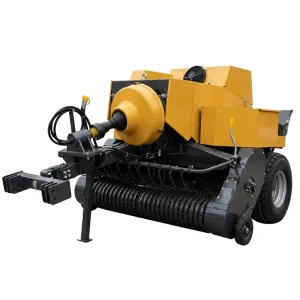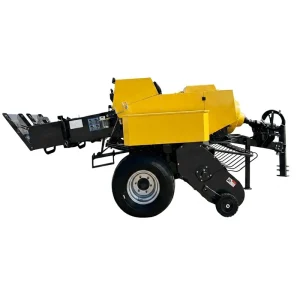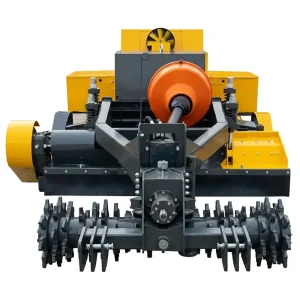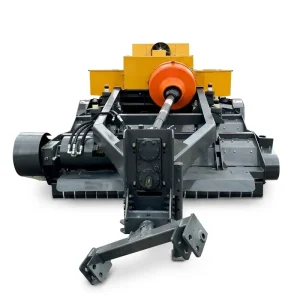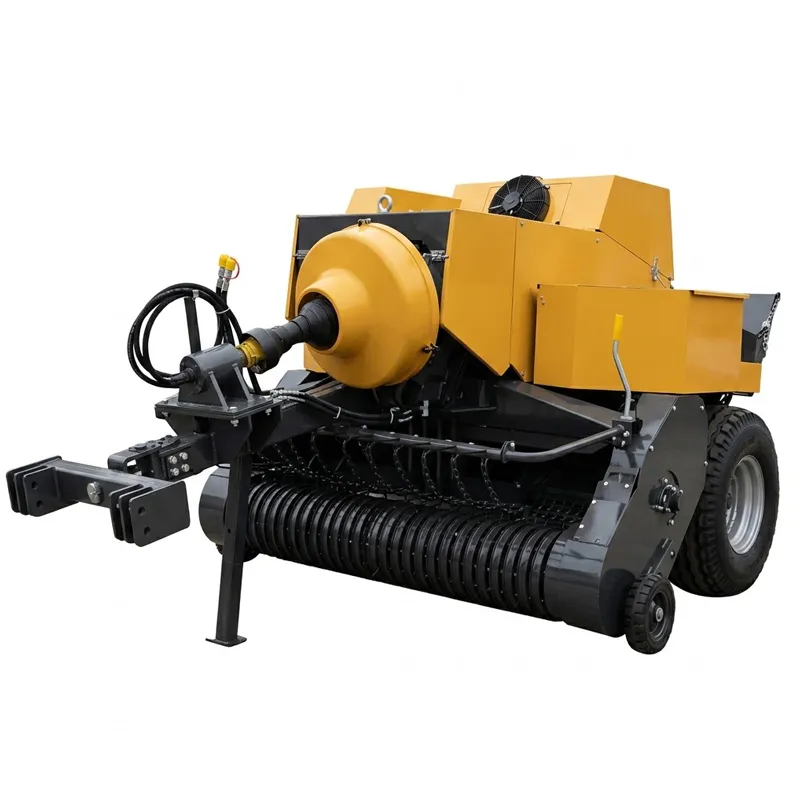
EP-4965×2500×1750mm LWH 1700mm Spring Tooth Square Baler
The EP-4965×2500×1750 is a mid-mounted, towed-type square baler developed specifically for operations that need reliable high-density bale output without requiring large row-crop tractor power. With a 1700mm picking width, it targets the mid-scale segment — broad enough to clear windrows efficiently, compact enough to maneuver in smaller paddocks and terraced fields common across East Asia and Eastern Europe.
Where this machine separates itself from lower-tier small square balers is in its spring tooth pickup system. Spring teeth adapt to uneven ground, following surface contours rather than fighting them.
The fork feeding mechanism transitions gathered crop into the inlet evenly, preventing the bridging and jamming that frequently interrupts operations during peak baling windows.
Spring Tooth Type · 1700mm Picking Width · Mid-Mounted Trailed Square Baler
EP-4965×2500×1750mm LWH
1700mm Spring Tooth Square Baler
A compact yet high-output trailed square baler designed for wheat straw, rice straw, cotton stalks, corn stover, and field forage crops. Built for reliable performance across paddy fields, dry farmland, and sloped terrain where surface uniformity is never guaranteed.
Technical Specifications
Full parameter sheet for the EP-4965×2500×1750mm 1700mm Picking Width Square Baler. Verified against factory build records.
| # | آئٹم | یونٹ | تفصیلات |
|---|---|---|---|
| 1 | ماڈل کا نام | — | EP-4965×2500×1750 Square Baler |
| 2 | Hitching Method | — | Towed-type |
| 3 | Picking Width | ملی میٹر | 1700 |
| 4 | Feeding Inlet Width | ملی میٹر | — |
| 5 | Picker Structure | — | Spring Tooth Type |
| 6 | Feeder Structure | — | Fork Feeding Mechanism |
| 7 | Knotter Type | — | D-type |
| 8 | Number of Knotters | pc | 2 |
| 9 | Compression Chamber Section (W×H) | ملی میٹر | 460×360 |
| 10 | بیلنگ کا طریقہ | — | Automatic Rope Baling |
| 11 | Matching Power Range | کلو واٹ | 29.5 – 73.5 |
| 12 | Overall Dimension (L×W×H) | ملی میٹر | 4965×2500×1750 |
| 13 | مشین کا وزن | کلو | 1750 |
How This Square Baler Works
The operating sequence of a square baler machine follows four distinct mechanical stages, each critical to bale quality and throughput consistency.
① Ground Pickup
The spring tooth reel sweeps forward across the windrow, lifting loose straw, grass, or crop residue cleanly from the field surface. The spring-loaded tine design is forgiving on uneven ground — a key practical advantage for paddy fields in Korea and Northern Asia where surface leveling after combine harvest is imperfect.
② Fork Feeding
Lifted material passes to the fork feeding unit, which meters crop into the compression inlet at a controlled rate. This prevents the bunching and bridging that causes compression chamber blockages — one of the most time-consuming interruptions in any baling operation, particularly when running light, fluffy straw types.
③ Plunger Compression
The plunger drives material into the 460×360mm compression chamber in successive strokes. Each stroke adds another layer to the growing bale. The chamber geometry produces square hay bales with high volumetric density — meaning fewer trips per tonne when loading, hauling, or stacking compared to loosely formed material from under-powered small square hay balers.
④ Automatic Knotting
When the bale reaches its target length, both D-type knotters fire simultaneously, tying twine around the bale without operator input. The finished bale ejects rearward onto the field. With two knotters running automatically, the operator can maintain forward speed through the entire baling cycle rather than slowing to manage tying events manually.
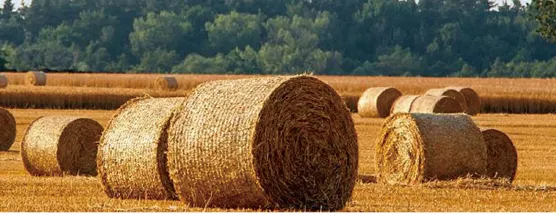
5 Reasons Farms Choose This Square Baler
Built for productivity in real harvest environments, not just factory test benches.
Wide Tractor Compatibility Range
The 29.5–73.5kW power range makes this a genuine square baler for compact tractor pairing — a 40hp utility tractor can run it, and an 80hp mid-size tractor can push it to full capacity. This flexibility reduces the barrier to entry for smaller farms while still serving commercial-scale operations running larger equipment.
Consistent Pickup on Irregular Ground
Spring tooth tines flex over clods, ridges, and soil irregularities without losing pickup contact — then spring back immediately. In fields that have not been power-harrowed after combine harvest, the spring tooth design recovers measurably more crop per hectare than rigid-tine alternatives. More straw picked up means more bales per acre and lower cost per tonne.
Stackable, Transportable Bale Format
The 460×360mm rectangular bale cross-section stacks flat and tight. When weighing how many square bales of hay fit per truck versus the dead space in round bale loads, the square format consistently delivers more payload per vehicle. For straw recycling businesses and biomass operations selling by the tonne, this makes a measurable difference in logistics cost.
No Manual Tying Intervention
Automatic rope baling removes one of the most disruptive stop-start events in traditional baling. Dual D-type knotters fire simultaneously with each completed bale, keeping the machine and tractor moving. Over a full day's operation, eliminating manual tying typically saves 45–60 minutes of downtime — meaningful productivity when harvest windows are measured in days.
Compact Machine Footprint
At 4965×2500×1750mm overall dimensions and 1750kg machine weight, this is a meaningfully lighter and shorter machine than the wider-swath models in our range. For farms with narrow gate access, terraced parcels, or transport width restrictions, the smaller footprint of this square baler machine matters at every stage — field, road, and storage.
Materials & Construction
Long service life in a square baler comes from the base materials, not from paint or marketing claims. Here is how this machine is built.
Structural Frame
Heavy-gauge welded steel box sections form the primary chassis. The frame geometry is designed to resist torsional deflection under repeated compression plunger loads, which cycle thousands of times per operating day. Weld joint integrity is checked at multiple points in the production process.
Spring Tooth Tines
High-carbon spring steel, heat-treated for fatigue resistance. Tine geometry is tuned for the balance between flexibility and recovery speed — tines that flex too easily lose pickup efficiency; tines that are too stiff break on impact. The current specification is the result of several field iteration cycles in actual harvest conditions.
Compression Chamber Liner
Wear-resistant hardened plate on compression and bale channel surfaces. This is the highest-abrasion area of any square hay baler — the liner extends chamber service life substantially compared to unhardened steel, deferring the most costly in-field repair that operators of older baler designs commonly encounter after 500–800 hours.
PTO Drivetrain
Forged and heat-treated gears throughout the PTO drivetrain. Sealed bearing assemblies on all rotating shafts reduce daily lubrication demands and provide protection against the fine crop dust and chaff that infiltrate conventional open-bearing designs during dry harvest conditions.
Application Scenarios
This square baler handles crop residue and forage baling across a wide range of production environments.
🌾 Rice Straw Post-Harvest Recovery
After paddy combine harvest across Korea, Japan, and Southeast Asia, large volumes of short, fine rice straw are left in loose windrows. The spring tooth pickup on this machine handles this light material efficiently, gathering cleanly without pulling up soil or stones that would contaminate bales and damage recipient processing equipment downstream.
🌽 Corn Stover Collection
Corn stover is one of the more challenging baling crops — bulky, moisture-retaining, and prone to causing blockages in machines not designed for it. The fork feeding mechanism on this baler controls material flow into the inlet at a rate the compression chamber can process cleanly, reducing the stover-related blockages that plague general-purpose small square baler designs not built for this crop type.
🌿 Wheat Straw Baling in Temperate Zones
In the wheat belts of Russia, Belarus, and Mongolia, post-harvest straw management is a large-scale logistical challenge. This machine's 1700mm picking width covers ground efficiently enough for commercial-scale straw contractors while remaining compact enough for farms with narrower field access routes and smaller storage facilities than operations running big square balers.
🐄 Livestock Feed & Bedding
Operations producing small square hay bales for dairy or beef cattle benefit from the consistent bale dimensions this machine produces. Square bales are easier to portion for daily feed allocation than large round bales, and they stack efficiently in existing storage without specialized handling equipment — important for smallholder livestock farms managing feed stocks manually.
♻️ Biomass Fuel Supply Chains
Biomass energy plants and agricultural waste processing facilities increasingly require contracted straw supply in uniform, stackable bale formats. The square bale output from this machine — consistent cross-section, high density — integrates directly into automated biomass handling conveyors without pre-sorting or reprocessing steps that add cost and handling time.
Regulatory & Safety Standards
Agricultural machinery crosses multiple regulatory jurisdictions. Below is a summary of the standards most relevant to this square baler and its PTO drivetrain in primary target markets.
South Korea — KS B ISO Framework
Korean agricultural machinery is governed under KS B ISO 4254 (agricultural machinery general safety) and KS B ISO 11684 (safety signs). PTO-driven towed implements must meet KS B 6024 guarding requirements. Korean buyers should confirm that PTO shaft and guard specifications match local compliance requirements before committing to a field deployment schedule.
EU — Machinery Directive 2006/42/EC
Towed agricultural implements entering EU member states require CE conformity under the Machinery Directive 2006/42/EC. PTO shaft shielding must comply with EN 1152. Buyers in Germany, the Netherlands, and other EU markets should request CE declaration of conformity documentation and verify that the supplied PTO shaft meets EN 12965 for tractor-to-implement connections before field use.
Russia & Belarus — EAEU TR Requirements
Within the Eurasian Economic Union, TR EAEU 010/2011 governs machinery safety and TR EAEU 018/2011 covers wheeled vehicle requirements where applicable. Russia additionally enforces GOST R certification for commercial agricultural equipment sales. Buyers in these markets should confirm current certification requirements with their customs agent, as documentation requirements are updated periodically.
Global PTO Standard — ISO 500
ISO 500 defines PTO shaft dimensions and rotational speed standards (540rpm and 1000rpm) that govern compatibility between tractors and PTO-driven implements worldwide. This square baler operates on standard 540rpm PTO, within the 29.5–73.5kW tractor range specified. Ensure the PTO shaft guard is intact and properly secured before every engagement — this is not optional in any jurisdiction.
System-Compatible Components
We supply matched drivetrain and transmission components built to work with this square baler from day one — no guesswork about fitment or compatibility.
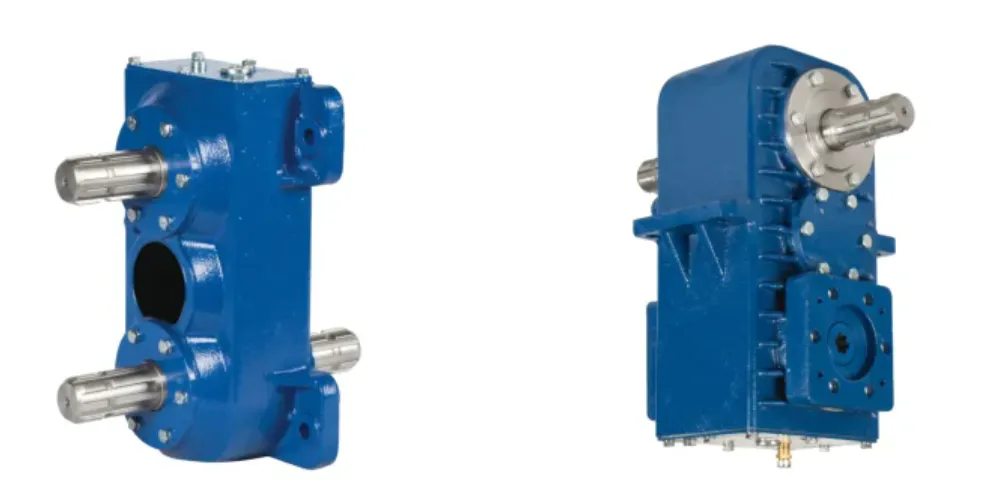
Square Baler Gearbox
A failing gearbox mid-harvest is not a maintenance event — it is a production loss. Our matched square baler gearbox units are dimensionally and specification-matched to this machine's drivetrain. Direct-fit replacement means no shimming, no machining, and no time lost to sourcing parts that almost fit. Keeping a spare on hand before the season begins is the single most effective insurance against harvest disruption.
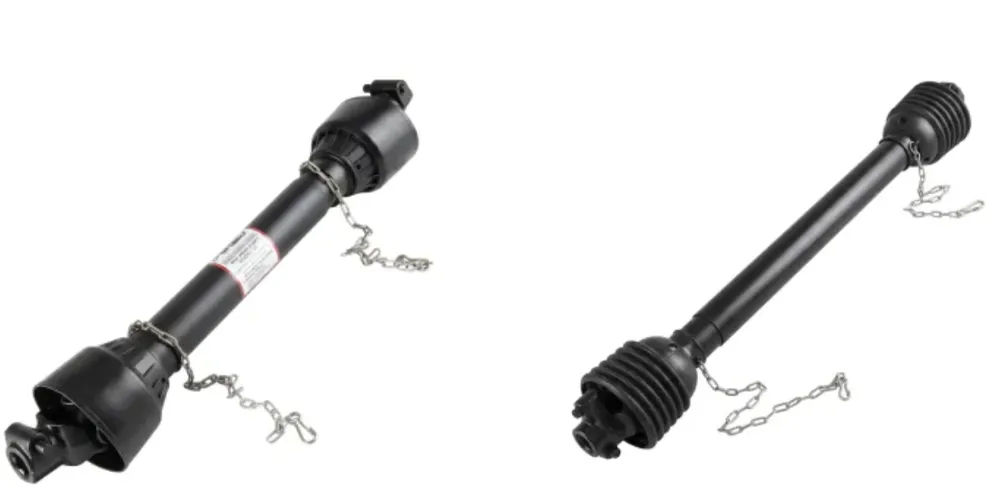
PTO Drive Shaft
The PTO shaft transmits all drivetrain torque from tractor to machine — it is the most stressed single component in the system. Undersized or worn shafts are a safety risk, particularly during the high-load compression cycles that characterize dense straw or corn stover baling. Our EP PTO Shaft for square balers is rated across the full 29.5–73.5kW tractor power range of this machine, with integrated slip-clutch overload protection. Available in custom lengths to suit different tractor-hitch configurations.
About Us — Ten Years in Agricultural Machinery
The people behind this machine are engineers who have worked farm equipment problems on actual farms, service technicians who have responded to breakdowns during harvest, and growers who understand what a failed machine at 6am costs in a narrow weather window. Post-harvest residue management is not an abstract logistics challenge for our team — it is something they have managed directly.
We started in 2021 with a 2,000-square-meter facility and a straightforward goal: build machines that work when farms need them, at price points that do not require buyers to choose between quality and financial viability. Too many operations were trapped between overpriced premium brands and underbuilt budget machines that failed precisely when the pressure was highest.
Growth has been consistent. Our production floor now covers 32,000 square meters of modern manufacturing space, and annual output has scaled from roughly 100 units to 2,000. Our machines are now working in Mongolia, Russia, Belarus, and across multiple export markets. The benchmark for everything we build remains the same: does it perform in the field under real conditions, not just in a factory acceptance test?
Frequently Asked Questions
Questions from farm operators, straw contractors, and equipment dealers across Korea, Russia, Mongolia, and global markets.
Q1. What is the minimum tractor horsepower required to run this square baler efficiently in paddy field conditions?
This machine accepts tractors from 29.5kW (approximately 40hp) up to 73.5kW (approximately 100hp). For paddy field operation with wet or heavy straw, we recommend running in the 50–70hp range to ensure comfortable headroom during dense baling cycles. Running at the absolute minimum power limit increases clutch wear and can cause hesitation during high-load compression events. A 55–60hp utility tractor is the practical sweet spot for most Korean paddy straw operations with this machine.
Q2. How does a spring tooth square baler differ from a rigid tine pickup model when baling rice straw in Korean paddy fields?
Rigid tines cannot flex. When they encounter a raised soil clod or an uneven surface after paddy harvest, they either miss the material sitting in the low spot or snap under impact. Spring tooth tines flex downward over the obstruction, maintain ground contact across the surface change, and return to their working angle immediately. In paddy fields where the post-harvest surface includes furrows, ridges, and wheel ruts from combine traffic, spring tooth pickup recovers measurably more straw per pass. Over a full harvest, the difference in bale count per hectare is meaningful.
Q3. How many square bales of hay or straw per acre can this baler typically produce in wheat stubble conditions?
Bale count per acre depends on standing crop yield and the moisture content at baling. In temperate wheat straw at typical yields, a range of 15–28 small square bales per acre is realistic for the 460×360mm cross-section this machine produces. Rice straw in high-yield paddy regions generally produces more bales per acre due to higher biomass per hectare. Your local agronomist can provide crop-specific estimates; actual bale count will vary from field to field based on these variables.
Q4. What is the typical weight of a square bale of hay produced by this baler, and does it vary by crop type?
Bale weight varies by crop density and moisture. Rice straw baled at 14–18% moisture in the 460×360mm cross-section typically weighs 18–28kg per bale. Wheat straw runs slightly heavier. Forage grass baled at higher moisture content can approach 35–40kg. How much does a square bale of hay weigh is one of the most common pre-purchase questions from livestock operators — the answer depends more on the crop and field conditions than on the machine itself. Always check your stacking and transport equipment rated load before field baling begins.
Q5. How does the cost of operating a square hay baler compare to hiring a round baler contractor for a mid-scale Korean grain farm?
Ownership vs contracting economics depend heavily on annual baling volume and local contractor rates. For farms baling consistently above 80–100 hectares per season, ownership typically becomes cost-effective within two to three seasons. Below that threshold, contracting may be cheaper when factoring in machine maintenance and seasonal storage costs. The additional consideration is availability — contracted round balers are often booked during peak harvest, while owning a square baler for compact tractor means you set your own schedule and respond to weather windows rather than a contractor's calendar.
Q6. Which type of baler is better for a small straw recycling business in Eastern Europe — a large square baler or a small square baler?
For straw recycling businesses focused on transport cost, the square format — regardless of bale size — is superior to round because bales stack flat with no dead space in vehicles. Between large and small square formats, the choice comes down to your bale-handling equipment and end-buyer specification. Many biomass buyers and mushroom substrate producers have standardized on specific bale sizes. If your buyers already have bale handling equipment dimensioned for a specific cross-section, match that specification first before selecting machine capacity.
Q7. Do manufacturers still produce traditional small square balers, and are they a viable option for Mongolian grassland operations?
Small square balers remain in active production and strong demand globally. For Mongolian grassland operations where small square hay bales are needed for winter livestock feeding and the available tractor fleet is compact utility equipment, a small square baler often fits the farm's practical constraints better than large format alternatives. This 1700mm picking width model sits in the mid-range — wider than a typical mini square baler but not as large as the wide-swath commercial formats. It is a common specification for Mongolian farms running 50–80hp tractors.
ایڈیٹر: PXY