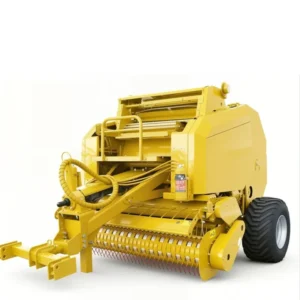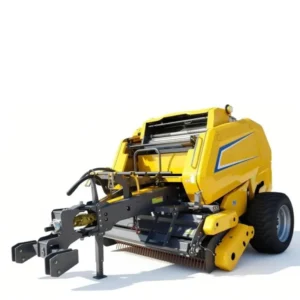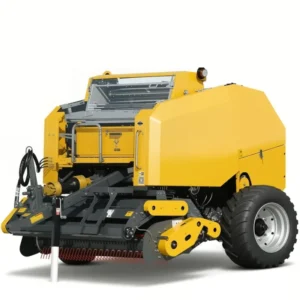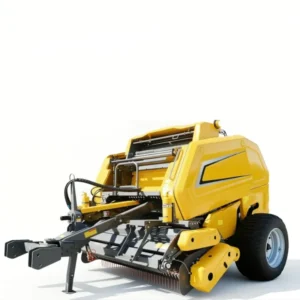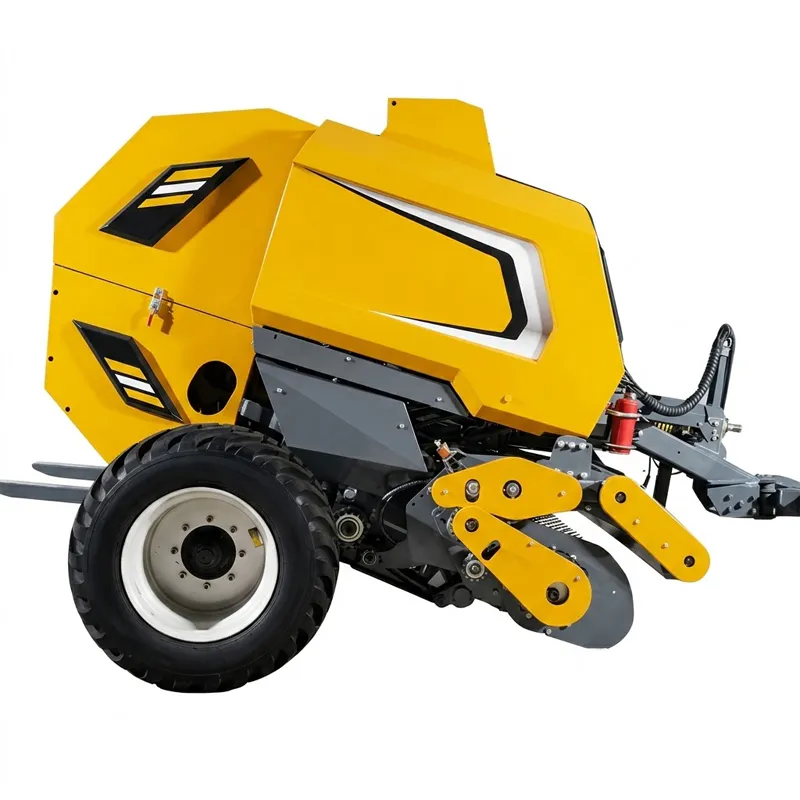
EP-4100×2900×2400 Spring Tooth Type Round Baler
这 EP-9YG-2.2 Round Baler is a high-performance trailed machine featuring a 2200mm spring tooth pickup and a continuous screw feeding mechanism. It produces dense round bales with a diameter of 1220mm and a chamber width of 1400mm, utilizing 18 roll-pressing components for optimal compression. Equipped with automatic net wrapping and a handheld color touch screen, it offers precise bale weight control via high-precision displacement sensors. The system supports both automatic and manual modes for full process monitoring. Key features include a fully automatic thin oil lubrication system for extended service life and a hydraulic pickup with floating capability to adapt to terrain. Requiring 110-150 kW power, this 3800kg unit ensures reliability with globally sourced components.
Agricultural Round Baler · Spring Tooth Pickup · 2200mm Picking Width
EP-4100×2900×2400 Spring Tooth Type Round Baler
A full-spec agricultural round baler engineered for large-scale hay and straw operations — built for reliability across Korea, Russia, Mongolia, Belarus, and global markets.
Technical Specifications
The table below details the full specification set for the EP-4100×2900×2400 round baler machine. All figures correspond directly to this model's factory configuration. Matching tractor power to the listed range ensures the transmission and PTO system operate within design tolerances.
| 不。 | 物品 | 单元 | 规格 |
|---|---|---|---|
| 1 | 型号名称 | — | EP-4100×2900×2400 Round Baler |
| 2 | Hitching Method | — | Towed-type |
| 3 | Picking Width | 毫米 | 2200 |
| 4 | Feed Inlet Width | 毫米 | — |
| 5 | Ficker Structure (Pickup Type) | — | Spring Tooth Type |
| 6 | Feeder Structure | — | Continuous Screw Feeding Mechanism |
| 7 | Type of Compressing Bale Chamber | — | Roll Drum Type |
| 8 | Width of Compressing Room | 毫米 | 1400 |
| 9 | Diameter of Compression | 毫米 | Φ1220 |
| 10 | Quantity of Roll-Pressing Working Components | pc | 18 |
| 11 | Diameter of Roll-Pressing Roller | 毫米 | Φ222 |
| 12 | Bundling Type | — | Automatic Net Wrapping |
| 13 | Matching Power Range | 千瓦 | 110 – 150 |
| 14 | Overall Dimension (L×W×H) | 毫米 | 4100 × 2900 × 2400 |
| 15 | 机器重量 | 公斤 | 3800 |
Operators frequently ask how many HP do you need to run a round baler of this class. The 110–150 kW power range corresponds to approximately 150–200 HP at the tractor PTO output, which keeps the transmission well within its rated load envelope during dense-crop conditions.
What Is a Round Baler and What Is It Used For?
A 圆捆打捆机 is a specialized agricultural machine designed to collect, compress, and bind cut forage crops — hay, straw, silage, and crop residues — into compact cylindrical bales that are easy to store, transport, and feed to livestock. When farmers and contractors ask what is the purpose of a round baler, the answer comes down to efficiency: a single pass across a windrow produces a dense, weatherproof bale that can weigh anywhere from 300 to over 700 kg depending on crop moisture and bale diameter. A typical round bale of hay weighs between 400 and 600 kg, allowing it to stay structurally sound during stacking and handling far better than smaller square-format alternatives.
The EP-4100×2900×2400 is a towed-type agricultural round baler built to handle high-throughput baling across large-acreage operations. With a 2200 mm picking width and a spring tooth pickup structure, it efficiently gathers wide windrows in a single sweep — reducing passes per field and fuel consumption per bale. It suits farmers running 80 kW to 150 kW tractors, contractors handling diverse crop types, and agribusinesses managing seasonal post-harvest residue at scale.
Five Key Performance Advantages
The wide-body spring tooth ficker structure lifts fragile or tangled crop material without breaking stems, reducing leaf loss in legume hay and improving overall bale density. Compared with standard tine pickups, the spring tooth design adapts to uneven ground and scattered windrows automatically, keeping intake consistent across varying terrain.
Material enters the bale chamber via a continuous screw feeding system that eliminates blockages common in high-moisture straw or heavy grass. The feeder structure maintains a steady, even material flow into the roll drum compressing chamber, which directly translates to more uniform bale density and fewer operator stoppages during peak baling windows.
The machine uses round bale net wrap technology with a high-precision sensor that counts wrapping loops automatically, enabling cost-effective use of net material without operator guesswork. Two operating modes — automatic and manual — give users full flexibility whether they are running fully attended or semi-autonomous baling runs.
The fully automatic thin oil lubrication system circulates throughout the entire chain drive transmission, significantly reducing wear on the 18 roll-pressing working components. Grease points are centralized for collection-style delivery, cutting maintenance intervals and extending the operational service life of round baler parts including chains, bearings, and clutch assemblies.
Drive shafts, bearings, clutch assemblies, chains, and the electronic control system are sourced from internationally recognized brand suppliers. This ensures the machine meets the reliability expectations of professional contractors in demanding markets including South Korea, Russia, Mongolia, and Belarus — regions where field downtime during harvest carries serious financial consequences.
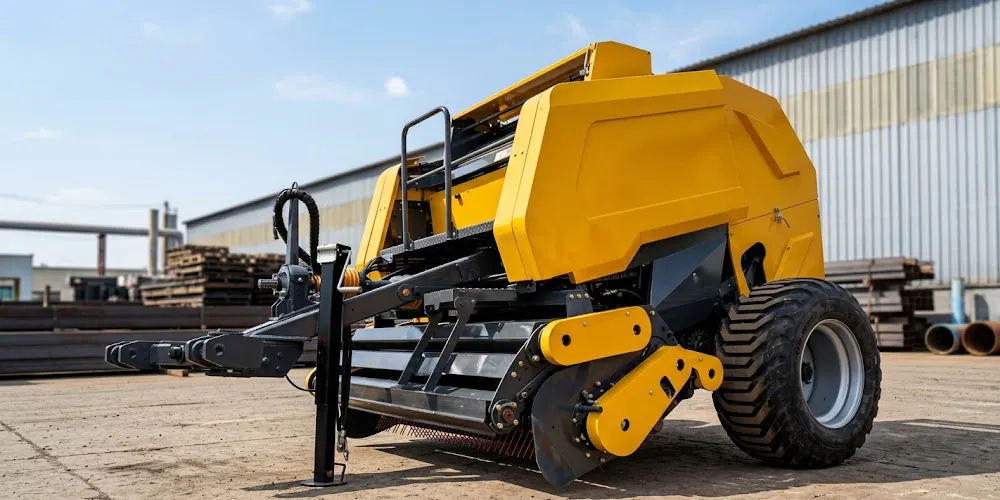
How the Round Baler Works
Understanding the working principle of a round baler machine helps operators set the correct tractor PTO speed and pre-compression settings for different crop types. The EP-4100×2900×2400 follows a sequential, sensor-monitored process from field pickup through bale ejection.
The spring tooth pickup lifts windrowed material from the ground and feeds it into the continuous screw feeding mechanism. The screw distributes material evenly across the full 1400 mm width of the compressing room, preventing side-loading on the drum rollers. Once inside the roll drum bale chamber, 18 independently rotating Φ222 mm pressing rollers begin winding the incoming crop into a cylindrical core. As bale diameter increases toward the target Φ1220 mm, sensor readings from the high-precision displacement system register compression force and diameter simultaneously. When the target size is reached, the electronic control system triggers the automatic net wrap cycle — the high-precision sensor counts net loops, applies the preset wrap count, and cuts the net cleanly. The rear gate then opens hydraulically, the finished round bale rolls clear of the machine, and the gate closes to begin the next bale cycle. The handheld color touchscreen displays machine status, bale count, and real-time weight estimation throughout the entire process, giving the operator full situational awareness without leaving the tractor cab.
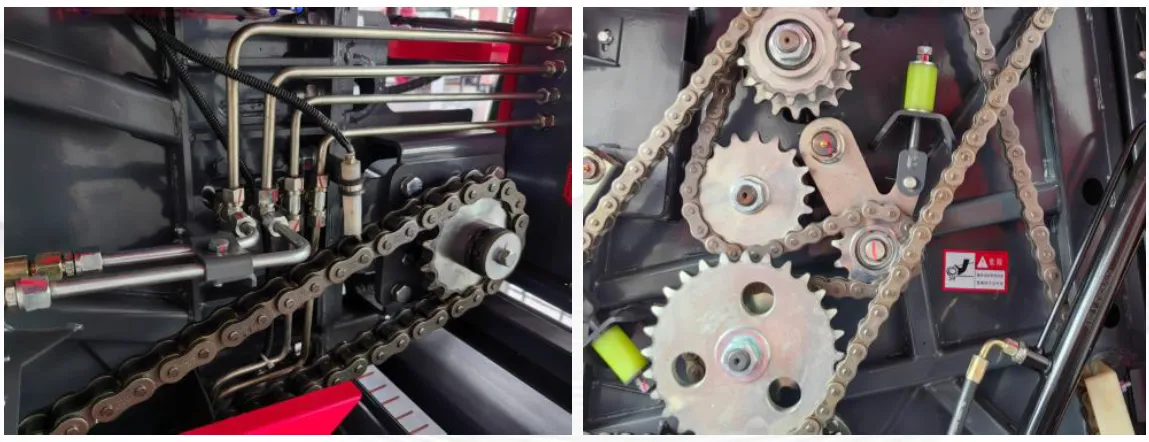
Materials and Build Quality
The frame and bale chamber housing are constructed from high-strength structural steel with full-perimeter welding at load-bearing joints, giving the machine rigidity needed to absorb the repetitive compression forces generated during continuous high-throughput baling. Pressing rollers are manufactured to Φ222 mm diameter with hardened surface treatment, resisting abrasive wear from sandy or gritty crop material common in dryland grain belts across Mongolia and the Russian steppe.
Key drivetrain components — the PTO input shaft, gearbox internals, clutch assembly, and chain sets — are sourced from internationally recognized suppliers and are not substituted with unverified alternatives. The thin oil lubrication system uses a centralized delivery architecture rather than individual grease nipples, which reduces the risk of missed lubrication points during high-volume season use. The hydraulic pickup height adjustment system uses quality-sealed cylinders with adjustable float settings, enabling the machine to follow undulating terrain without operator intervention. All external surfaces receive a corrosion-resistant primer and topcoat suited to outdoor agricultural storage between seasons.
These material choices are not incidental — they directly influence how long round baler parts last between replacements, and how much unplanned downtime a contractor or farming operation absorbs across a three-to-five-year ownership cycle.
Round Baler Application Scenarios
这 round baler application range for the EP-4100×2900×2400 covers the major post-harvest and forage-management scenarios found on large commercial farms and in contractor operations across Asia, Europe, and South America.
After grain harvest, the spring tooth pickup efficiently gathers dry straw windrows across wide stubble fields. Compact bales reduce field residue, enable faster tillage turnover, and provide a storable straw product for animal bedding or biomass markets.
The spring tooth pickup is well-suited to round hay baler operations where leaf preservation matters. Gentle material handling at the ficker stage reduces leaf shatter in leafy legumes, protecting the nutritional quality of the bale. Net wrapping seals the outer surface to shed rain.
Following maize harvest, the continuous screw feeder handles the bulkier and more tangled structure of corn stover without plugging, allowing contractors to process large volumes per shift. The resulting high-density bales support biomass energy supply chains and livestock bedding operations.
Cattle and dairy operations across Russia, Mongolia, and Korea rely on pre-formed round hay bales as the core winter feed buffer. At roughly 400–600 kg per bale, the EP round bale format aligns with loader handling capacity on most medium-large livestock facilities, and net wrapping keeps bales intact during outdoor storage.
Custom contractors in seasonal baling markets benefit from the 2200 mm pickup width and high-throughput drum chamber, which allows more acres per day per machine. The touchscreen monitoring system simplifies operator handovers between shifts, keeping utilization rates high during the short harvest window.
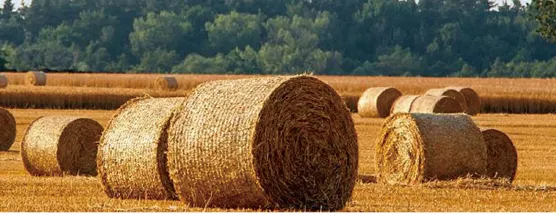
Compatible Accessories & System Components
A complete baling system goes beyond the baler itself. We supply matched drivetrain components that are tested for compatibility with this series, supporting one-stop sourcing for contractors and dealers who want to avoid mismatched parts.
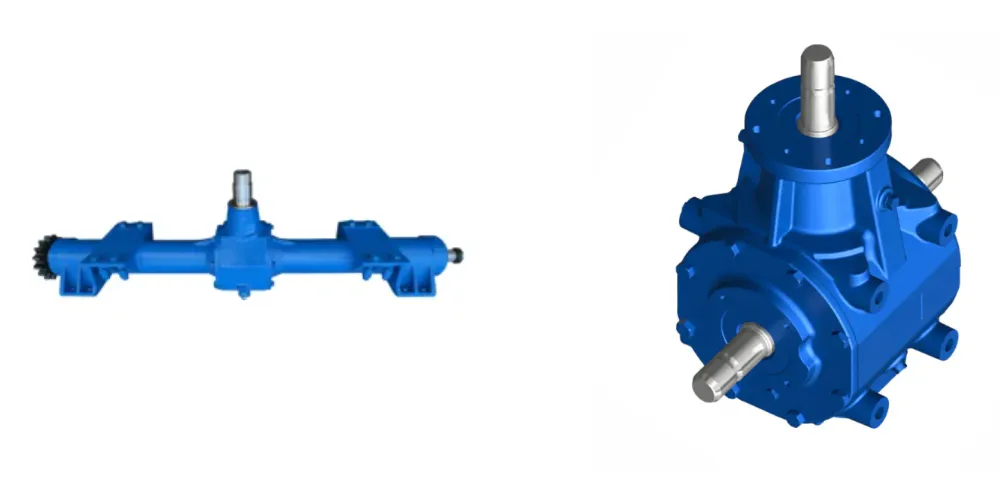
这 round baler gearbox is one of the highest-wear components in towed baling systems. We manufacture and supply matched gearboxes designed for the torque and RPM profiles of this baler series, ensuring consistent PTO power transfer through heavy-crop baling cycles.
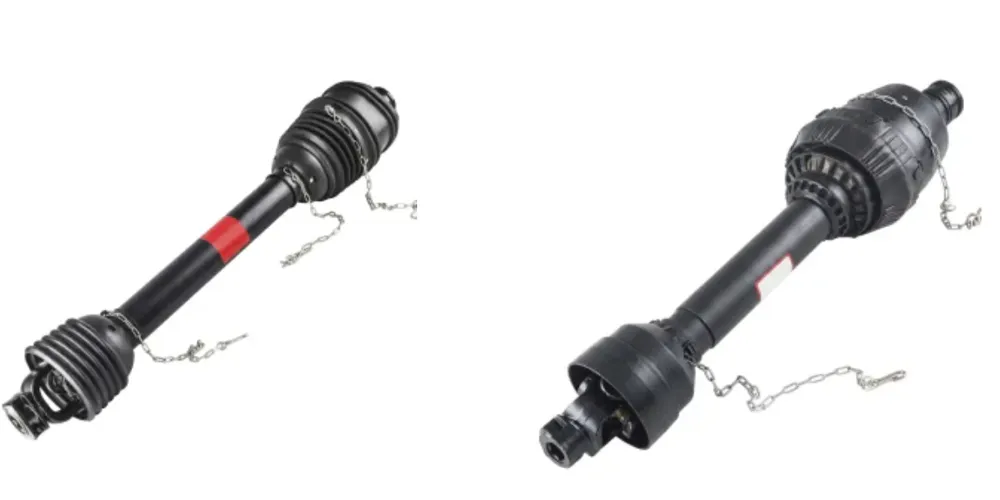
The PTO shaft connects tractor and baler, transmitting rotational power under constant vibration and angular variation. Our purpose-matched PTO shafts for round baler applications are dimensioned for the torque loads generated by this model's drum chamber during high-density baling. Proper shaft length and cross-joint angle alignment protect both the tractor gearbox and the baler input shaft from premature wear.
About Our Team
Our team brings together agricultural engineers, working farmers, and field service technicians — people who understand what post-harvest residue management actually looks like from ground level, not from a product catalog. When a round baler plugs during peak harvest or a gearbox fails mid-season, we know what that costs.
What started as a 2,000 m² workshop has grown into a 32,000 m² modern production facility with intelligent manufacturing lines over the past decade of engineering experience. Annual production capacity has scaled from 100 units to 2,000 units, and our sales reach now covers export markets across Mongolia, Russia, and Belarus — alongside our expanding network of dealers across Korea and Southeast Asia. We saw too many farms stuck between overpriced imported machines and under-engineered local alternatives that couldn't hold up through a full baling season. That gap is what we built this range to close.
Every machine that leaves our floor goes through a structured pre-shipment inspection, and our service network supports customers with spare parts availability and technical support in their regional time zone. We stand behind every agricultural round baler in this lineup with the same confidence we'd put behind equipment running on our own fields.
Frequently Asked Questions
Which type of round baler works best for large-scale hay operations in South Korean farming conditions?
For large-acreage hay and straw baling in Korea's relatively flat paddy and upland grain regions, a towed-type round baler with a spring tooth pickup in the 2200 mm width range is typically the most productive choice. The spring tooth structure handles both dry straw and semi-moist grass without significant blockage risk, and the 110–150 kW power range matches the common mid-to-large tractor fleet in Korean commercial farming operations. Net wrapping further supports outdoor bale storage during Korea's variable autumn weather.
How many square bales are in a round bale produced by a machine with a 1220 mm bale diameter?
The number of square bales equivalent to one round bale depends on crop type, moisture content, and compaction. As a general benchmark, a Φ1220 mm diameter × 1400 mm wide round bale of dry straw or hay weighs approximately 350–500 kg. A standard small square bale typically weighs 20–30 kg, meaning one round bale from this machine is roughly equivalent to 15–25 small square bales. The figure shifts with density, so higher-moisture crops or tighter drum compression settings produce heavier, denser bales that represent more square-bale equivalents per cycle.
What agricultural round baler maintenance schedule should contractors follow during peak baling season in Russia or Mongolia?
For contractors running high daily output in Russia or Mongolia's short harvest windows, a daily pre-start inspection covering chain tension, centralized lubrication system oil level, and roller condition is the minimum routine. The thin oil system significantly reduces daily grease points compared with older nipple-based systems, but the main reservoir should still be checked every 50–80 operating hours. Chain and sprocket wear should be assessed weekly during continuous-use periods. Net wrap roll changes and sensor calibration verification are recommended every 500 bales or at the start of each new crop type to maintain wrap consistency.
Where can I source compatible round baler gearbox replacements for an EP series baler used in commercial hay production?
Replacement round baler gearbox units matched to EP series balers are available directly through our parts channel. Because the gearbox is a high-load component subject to seasonal fatigue from PTO torque cycles, using a manufacturer-matched unit avoids shaft engagement issues and input torque mismatches that arise with generic aftermarket alternatives. Contact our export sales team with your model reference for lead time and compatibility confirmation, or browse matched gearbox options online via the accessory link listed in the compatible accessories section of this page.
When is the right time for a hay farming operation in Northeast Asia to invest in a full-size round baler versus a mini round baler for smaller fields?
The decision between a full-size agricultural round baler and a mini round baler comes down to field size, bale handling infrastructure, and the size of the tractor fleet. A full-size machine like the EP-4100×2900×2400 is designed for operations managing 200+ hectares per season with tractors in the 110–150 kW class. If the operation runs smaller tractors (below 60 kW) or fields that are broken into small irregular plots where a wide-body pickup creates headland waste, a mini hay baler may produce better per-field economics. However, when output volume is the priority and loader-fed livestock feeding infrastructure is already in place, the larger round baler's higher throughput and lower cost-per-bale typically delivers a stronger seasonal return on investment.
编辑:PXY